person svgrepo com PERSONAL INFORMATION


Civil information Contact

location 17 Impasse des Hirondelles
67590 Wintershouse (France)

tel +33 (0)6 95 43 83 44, +33 (0)7 67 55 71 22 (SlashEtc)

calendar svgrepo com 3 May 1974

mail michel.mehl.pro@gmail.com

boy hair shape svgrepo com Sex Male

internet svgrepo com wwww.slashetc.fr

france vector svgrepo com Nationality French

messaging whatsapp +33 (0)6 95 43 83 44

car svgrepo com Driving-licence B (+25 years)

linkedin svgrepo com www.linkedin.com/in/michel-mehl-9776ba90

pen1 svgrepo com PERSONAL STATEMENT

Entrepreneur and Independent Software Engineering
Autonomous, versatile, committed and service-oriented, I provide IT and consulting services in software engineering on a wide panel of technologies. I also work as an individual entrepreneur (registered at Trade and Companies Register of Strasbourg) to develop my own ideas and products (wwww.slashetc.fr).

hammer and wrench tool wrench construction tools svgrepo com WORK EXPERIENCE

2024
present
                                                     

location SlashEtc, Wintershouse.

2025

PhotobookMaker product

PhotobookMaker enables to generate within minutes professional numeric and printable photo albums from a set of photos and videos files. tools svgrepo comBASH, awk, HTML5, CSS, Javascript, AsciiDoctor, Docker, vsftp, Ubuntu 24 server, Nodejs, Express LVM

Demo albums: https://slashetc.fr/photobookmaker/demos

2024
2025

Mountpilot product

Mountpilot is a Linux system administration tool which primary goal is to enable to mount on the local file system data devices of any technology, network resources of any protocol and disk files of any type from a common, simple and intuitive command line interface (CLI) and a text-UI interface.

tools svgrepo comBASH, awk, findmnt, lsblk, udevadm, sgdisk, gdisk, parted, sfdisk, ethtool, ip addr/route, nslookup, host, lsusb, nfs (nfs-kernel-server, nfs-common), ftp (curlftpfs), google-drive-ocamlfuse, cifs, ssh (fuse sshfs), overlay fs, luks (cryptsetup), VERA (veracrypt), qemu-utils (qemu-nbd), mkfs, wipefs, dd, dmsetup, pvs, lvs, vgchange, losetup, iwconfig, nmcli, df

2018
2024

location BENETT PORTAGE, Strasbourg (France).

Multiple missions for DEUTA-WERKE-GmbH, Bergisch-Gladbach, Germany, a world-wide supplier of embedded systems for the Railways, among which safety-relevant terminals for the Drivers, safe onboard Recorders, odometer systems. A summary of main expertise acquired is available on the online CV.

Acquired Expertise

Main completed and acquired expertise:

  • DEUTA:

    • DATS-based terminals,

    • REDBOX 1&2 recorders,

    • ADS3,

    • IconTrust/SelectTrust,

    • IVEN 1&2

    • DATF

  • Organisational: Remote team work supported by suitable tools.

  • ERTMS/ETCS: NTRs and NNTRs and related specs.

  • Development:

    • BASH

    • Python

    • Data processing through XML/XSL

    • PROFINET bus

    • Requirements handling processing with JAMA.

    • Git and related tools for CM.

    • DevOps with GitLab

    • Doctest (C++).

    • Ethernet related protocols and related sniffing tools.

  • Systems: Linux system tools for administration, inspection, benchmarking.

  • Documentation:

    • Programmatic writing and requirements-based writing of documentation,

    • Diagrams programming and drawing tools.

  • Other: GPS protocol, NMEA.

2023/11
2024/10

Requirements Manager and Documentation writer for HITACHI DMI for UK

Requirements, Software Design and traceability with respect to the EVC-DMI messages and their sending conditions were thoroughly completed in JAMA, in a reverse engineering process involving a code analysis as starting point. 54 Use Cases, 59 Sequence Diagrams, 30 issues open in bug tracking. tools svgrepo com JAMA, AsciiDoctor, PlantUML, Python.

Activity details

Mission and responsibilities

  • Carry out a source code analysis of the HITACHI DMI for UK to get an extensive picture of the EVC<→DMI message handling and sending conditions: determine which messages are used, which are not, when and how their are used.

  • Complete the requirements hold in JAMA accordingly, ensuring traceability from Stakeholder requirements up to the Design and the source code.

  • Support the documentation with graphical representations, i.e. Use Cases and Sequence Diagrams pertaining to those messages.

Achievements

  • 54 Use Cases

  • 59 Sequence Diagrams

  • 30 issues open in bug tracking

  • Code analysis and full understanding of the EVC/DMI interactions

  • UC (Use Cases) and SQ (Sequence Diagrams) written in AsciiDoc and PlantUML as a first step

  • Importation in JAMA via MS WORD: AsciiDoc → MS WORD → JAMA

Techniques, tools, norms and specifications

  • Languages: C++, BASH, Python

  • Platform: Ubuntu 22, Windows

  • Process tools: Git, GitLab, CMake, Make

  • Requirements tool: JAMA

  • Documentation: AsciidDoctor, PlantUML, JAMA, MS WORD

2023/03
2023/11

Requirements Manager REDBOX 2K

In a pair work, creation of a central requirements database collecting and sorting all NNTRs (Notified National Technical Rules) applicable to recording devices for the following countries: NL, BE, FR, ES, UK, DK, SE, NO, FI, AT, PL, HU, CZ, SK. Hardware requirements collection from NTRs and national recording systems (Havarilog/DK, ATESS/FR,ARR/NL, TELOC).

tools svgrepo com JAMA, AsciiDoctor, Python, Mermaid. book svgrepo com EN 62625, EN 15746, GM/RT2472,RIS-2472-RST, TSI LOC&PAS, TSI CCS, TSI WAG, SUBSET-026, SUBSET-027, SUBSET-035. train fill svgrepo com PZB90, LZB, INDUSI I60, Crocodile, KVB, KVBP, TVM 300 & 400, NExTEO, KCVB, KCVP, DAAT TPWS/AWS, TBL, TBL1+, TBL2, MEMOR ZUB123 ATP-VR/RHK (EBICAB900) ATB-EG, ATB-VV, ATB-NG ATC/EBICAB700, ATC/L10000 (ATC2), SHP, PKP radio system

Activity details

Mission and responsibilities

  • Setup a central requirements database in JAMA for collecting and sorting all the NNTRs applicable to recording devices (Notified National Technical Rules):

  • In the scope of the future REDBOX 3K platform, get a full picture of additional hardware requirements arising not only from the NNTRs, but also more globally from all National Technical Rules (NTRs) and country-specific recording systems.

This included the following activities:

  • Investigating the internal already processed NNTRs in existing projects (BE, NL, ES mainly)

  • Investigating the official sources: ERA, ERA RDD (Reference Document Database), legal instances of each country

  • Offshore investigating on the web on national-specific systems and hardware

Achievements

  • NTR/NNTR JAMA databases for the following countries:

    • The Netherlands (NL)

    • Belgium (BE)

    • France (FR)

    • Spain (ES)

    • United Kingdom (UK)

    • Denmark (DK)

    • Sweden (SE)

    • Norway (NO)

    • Finland (FI)

    • Austria (AT)

    • Poland (PL)

    • Hungary (HU)

    • Czech Republic (CZ)

    • Slovakia (SK)

  • Hardware requirements collection from NTRs and national recording systems (Havarilog/DK, ATESS/FR,ARR/NL, TELOC systems)

  • NNTR database quick prototyping process based on AsciiDoctor for the writing and Python for the importing of specific parts into JAMA.

  • Overview of national Class B systems and STMs

Techniques, tools, norms and specifications

Norms and specifications:

  • EN 62625,

  • EN 15746,

  • GM/RT2472,

  • RIS-2472-RST

  • TSI LOC&PAS,

  • TSI CCS, TSI WAG

  • SUBSET-026,

  • SUBSET-027,

  • SUBSET-035,

Class B systems:

  • PZB90,

  • LZB,

  • INDUSI I60,

  • Crocodile, KVB, KVBP, TVM 300 & 400, NExTEO, KCVB, KCVP, DAAT

  • TPWS/AWS,

  • TBL, TBL1+, TBL2, MEMOR

  • ZUB123

  • ATP-VR/RHK (EBICAB900)

  • ATB-EG, ATB-VV, ATB-NG

  • ATC/EBICAB700, ATC/L10000 (ATC2),

  • SHP, PKP radio system

Tools and techniques:

  • AsciiDoctor

  • JAMA

  • Python

  • Mermaid diagrams

2022/04
2023/07

PROFINET Developer and Tester for REDBOX 2K

  • REDBOX 2K recorder was extended with PROFINET according to Real Class 1, CC-B.

  • Functional tests written and run for CODESYS test environment and soft PLC running Raspberry Pi.

  • Passed certification with official test bundles V2.42 and V2.43 of the PI consortium.

  • Documentation: PROFINET insights, GOAL stack, Howto’s: testing with CODESYS, passing Certification.

book svgrepo com PROFINET specs V2.41, V2.42, V2.43. tools svgrepo com PLC script (Programmable Logic Controller), ethtool, ifplugd, tcpdump, wireshark, arp, route (Win), snmpget, snmpwalk, socat. REDBOX 2K (RB2ad), Raspberry Pi 3 Model B Plus Rev 1.3, NET-PowerControl power strip family, 2-wire RJ45 cabling. Test with CODESYS IDE V3.5 (Windows), SoftPLC Add-on for Raspberry Pi MC SL 4.4.0, Automatic RT Tester (ART) V2.42 and V2.43, Netload tester (SecurityLevel1-Tester), GSD checker. Protocols: 802.3, DCP, LLDP, UDP, VLAN, SNMP, I&M records. APIs and stacks: GOAL PROFINET stack V2.22, V2.23. Qualifications: PROFINET certificate for device RB2ad.

Activity details

Mission and responsibilities

  • Integrate the PROFINET fieldbus into the REDBOX 2K recording device according to Real Class 1, CC-B (Conformance Class B).

  • Perform the functional tests with the CODESYS test environment with a soft PLC running Raspberry Pi.

  • Perform the certification pretesting using the official test bundles V2.42 and V2.43 of the PI consortium.

Achievements

  • Development of the application-level driver responsible to manage communications with PROFINET field bus over the GOAL PROFINET stack

  • Build and integration of the GOAL PROFINET stack V2.22, V2.23 for the low-level PROFINET communications

  • Definition of the project-specific GSDML specifying the characteristics of the PROFINET protocol and communication data:

    • Single PROFINET port (Real Class 1, CC-B)

    • 1 x Read/write Record

    • 1 x Read-only Record

    • 1 Input Module for cyclic output data (from REDBOX)

    • 1 Output Module for cyclic input data (to REDBOX)

    • I&M 0,1,2,3

  • Definition and performance of functional tests with CODESYS V3.5 SP18, using the SoftPLC Add-on for Raspberry Pi MC SL 4.4.0.

    • Full toolsuite installation, including update of PI device with the soft PLC V4.4.0

    • CODESYS project creation

    • CODESYS project parameterizing/programming (script)

  • Performance of the certification pretesting using the official test bundles V2.42 and V2.43 of the PI consortium.

    • Installation and test running with Automatic RT Tester (ART) V2.42

    • Installation and test running with Automatic RT Tester (ART) V2.43

    • Debug with generated dumps (Wireshart) with support of PN spec and PN test spec

  • Form Filling for the official PROFINET testing

  • Documentation:

    • Design of PROFINET application driver

    • Testing PROFINET with CODESYS

    • Pretesting for PROFINET certification

    • Pragmatic guide and insights on the PROFINET fieldbus

Techniques, tools, norms and specifications

Norms and specifications:

  • PROFINET specifications and test specifications Versions 2.41, 2.42, 2.43

Tools and techniques:

  • Languages: C++, BASH, PLC script (Programmable Logic Controller)

  • System tools: ethtool, ifplugd, ip, tcpdump, wireshark, arp, route (Win), snmpget, snmpwalk, socat

  • Platforms: Ubuntu 20, Windows 10/11, Raspberry PI, REDBOX Embedded Linux

  • Process tools: Git, GitLab (CM), CMake, Make (build)

  • Hardware: REDBOX 2K (RB2ad), Raspberry Pi 3 Model B Plus Rev 1.3, NET-PowerControl power strip family, 2-wire RJ45 cabling,

  • Documentation: AsciidDoctor, Mermaid diagrams

PROFINET:

  • Languages: GSDML

  • Test tools: CODESYS IDE V3.5 (Windows), SoftPLC Add-on for Raspberry Pi MC SL 4.4.0, Automatic RT Tester (ART) V2.42 and V2.43, Netload tester (SecurityLevel1-Tester), GSD checker,

  • Protocols: 802.3, DCP, LLDP, PROFINET Real Class 1 CC-B, UDP, VLAN, SNMP, I&M records

  • APIs and stacks: GOAL PROFINET stack V2.22, V2.23

  • Qualifications: PROFINET certificate for device RB2ad

2022/10
2023/01

Fixed communication data redundancy and data loss bug in DTAF teststand BG_30

DTAF is a robot-based integrated test stand which enables to stimulate a DMI system using a REDBOX as a CAN bus communication gateway. tools svgrepo com. ethtool, tcpdump, DATS displays, REDBOX, CAN open driver.

Activity details

Mission and responsibilities

  • Fix bugs in the REDBOX when used as communication gateway in the DTAF test environment (related to the lifesign handling in I60R DMI projects). 4 tickets solved (overall data redundancy or data losses and delays).

Achievements

  • Fix in CANopenDriver regarding data forwarding from Ethernet to CAN and reverserly.

  • Contributing to the redesign of the REDBOX/DTAF communication protocol and its integration in REDBOX (TcpStreamer).

  • Fix and adaptation of the TcpStreamer unit tests

  • Introduction to the python base of DTAF

  • Documentation:

    • Guide for the setup, use and maintenance of the REDBOX when used as communication gateway in test stands controlled with DTAF.

2021/03
2022/04

Refactoring of the unit and module tests of the REDBOX App (MFR)

CxxTest tests were ported to doctest (493 tests, 18155 useful lines of code). Fix, completion, modernizing, refactoring and creation of new tests (GPS driver). Increased test coverage from 35% lines (22616 out of 64641) to 53% (41991 out of 79204) as of April 2022, and from 6% branches (19564 out of 328311) to 18.3% (72808 out of 398286). Bugs uncovering and documentation (~ 40 GitLab issues). book svgrepo com NMEA 1083 (2.2), NAVMAN NMEA (2004). tools svgrepo com doctest (C++ test framework), CxxTest, Valgrind, kroki, Doxygen, landslide, JavaScript, HTML/CSS, RapidJSON, MFR application, ADS3 (DEUTA), ADS4, MFR configuration.

Activity details

Mission and responsibilities

  • Port from CxxTest to doctest the existing unit tests of the REDBOX application software

  • Maintain and develop of all unit tests and module tests

Achievements

  • Port of all existing CxxTest tests to doctest (493 tests, 18155 useful lines of code) and reactivation of unmaintained commented tests

  • Fix, completion, modernizing and refactoring (if necessary) of the following tests: SignalIOMain, FileRing, StoreManager

  • Development of new tests: GPS driver

  • A test framework for module tests, incl.:

    • scenario definition and execution framework,

    • thread-safe mocking framework with breakable mocked function calls,

    • MFR-dedicated Mock class library,

    • logging framework,

    • simple scenario language for message/telegram stream filtering

  • Increased test coverage from 35% lines (22616 out of 64641) to 53% (41991 out of 79204) as of April 2022, and from 6% branches (19564 out of 328311) to 18.3% (72808 out of 398286)

  • Bugs uncovering and documentation (~ 40 GitLab issues, more bugs behind)

  • Self-initiated fixes and API extensions in some libraries of the MFR application (when agreed)

  • In-depth insight of the MFR application, its main functions, interface, architecture and detailed implementation and design of packages and modules.

  • Documentation:

    • Architecture and design of MFR application (~3300 words)

    • Detailed module design of GPS driver (GPSDriver) (~2700 words)

    • Detailed module design of store manager (StoreManager) (~4200 words, ~20 figures)

    • Detailed module design of platform abstraction layers (Implementations of Platform::IPlatform)

    • Module test specification and report for GPS driver (GPSDriver) (~16000 words)

    • Module test framework documentation (~7500 words)

    • Maintenance guide of the unit and module tests documentation

    • CxxTest-to-doctest port report]

    • REDBOX Wikis

Productivity tools:

  • CxxTest-to-doctest code conversion tool

  • A Markdown-to-HTML/javascript/CSS slides generator basing on landslide

Wikis and workshops

  • Wikis on Virtual machine disk maintenance: Disk housekeeping, Shrinking disk capacity, Shrinking inflated disk, Workshop on the doctest-based module test framework

Techniques and tools

  • Standards: NMEA 1083 (2.2), NAVMAN NMEA (2004)

  • Languages and format: ADS3 (DEUTA), C, C++11, JavaScript, Mermaid, Graphiz/DOT, AsciiDoctor, Markdown, UML, GitLab CI configuration (YAML), JSON, XML, SVG, HTML, CSS

  • Environment:

    • Windows 7 Professional

    • Remote Windows desktop via Horizon with RSA SecurID

    • Ubuntu 18 (VirtualBox),

    • Ubuntu 20 (Native dual boot with Windows 10),

  • Tools:

    • Development tool chain: GNU tools (gcc etc.), CMake, Ninja

    • Editors: Visual Studio Code, Atom, Emacs

    • Development process: Git, GitLab, Mantis Bugtracker

    • Development libraries: RapidJSON

    • Test: doctest (C++ test framework), CxxTest, Valgrind

    • Supporting tools: Docker, qemu

    • Documentation: Visual Studio Code, VSC extensions (AsciiDoc,GraphViz), kroki, Doxygen, landslide, mdspell

    • Communication: MS Teams, Circuit, Rocket chat, MS Outlook OWA

  • Languages: English, German

2021/09
2021/09

Code reviewer for the REDBOX 2K recorder app

Code analysis and review was carried out for proving no functional impact of changes induced by switching from an Influx database to a file ring solution for the data storing in the EN50128/SIL0 app. software. tools svgrepo com C++, Doxygen, mdspell.

Activity details

Mission and responsibilities

This small 2-week mission was about carrying out a code analysis and review for proving no functional impact of changes induced by switching from an Influx database to a file ring solution for the data storing in the ENRO50128/SIL0 application software of the REDBOX 2K recorder for Flirt 3.1 for Stadler trains operating ETCS/I60R in Slovenia.

Achievements

  • Code analysis report used as input for the renewed assessment of Recorder

  • 5 non-blocking findings tracked as l

  • 87 changed source files reviewed per diff

  • Overall [design of MFR application, used as stepping-stop for the internal design documentation

  • Maintenance guide of the code review document

Techniques and tools

  • Languages and format: C++, Graphiz/DOT, Markdown, XML, SVG

  • Environments: Ubuntu 18 (VirtualBox)

  • Tools

    • Editors: Atom

    • Development process: Git, GitLab

    • Test: meld, Git

    • Documentation: Markdown, MS WORD, Doxygen, mdspell, online graphiz tool

    • Communication: Circuit, Rocket chat, MS Outlook OWA

  • Languages: English, German

2021/01
2021/05

Tester on the IconTrust first generation

The modified code parts (C language) of SDATA software module of IconTrust first generation, liable for processing the safe data within the SSF function (Safe Supervision Function), was thoroughly reviewed and tested according to EN50128 in the scope of a SIL2 assessment. book svgrepo com EN50128/SIL2. tools svgrepo com doctest (C++ test framework), gcov, lcov, genhtml, meld, Wftools (DEUTA internal), Swagger.

Activity details

Mission and responsibilities

  • Review and test of the modified code parts (C language) of SDATA software module of IconTrust first generation. The module SDATA is liable for processing the safe data within the SSF function (Safe Supervision Function) run by the redundant micro-controllers of a MFTS11 display.

  • Carry out activities according to EN50128 in the scope of a SIL2 assessment.

  • Production of the related SIL2 deliverables, i.e:

    • Verification and test plan according to the master Software Verification and Validation Plan (SVVP)

    • Verification and test report

    • Test results and artifacts

    • Traceability to the related input requirements

    • Evidence of no impact on SSF functionality

Achievements

  • Accquisition of the IconTrust first generation requirements and architecture

  • Verification and test according to EN50128:2011 at SIL2, tables A.5, A.13, A.14, A.19, A.21

  • Definition of test environment and tools, justification of used tools (class T1 and T2)

  • Software change analysis and confirmation of required tests (14 tickets)

  • Definition of test cases

  • Implementation of the SDATA module test harness and test framework self-test

  • Test coverage handling and documentation

  • Issues handling with Assessor

  • Update of the JAMA project (VEK2795_Hitachi_SSF_BL3MR2):

    • Test plan

    • Test cases specification

    • Links to related input requirements

    • JAMA test run report

  • Final assessable documentation:

    • Test plan and test report or the SSF-SDATA module for (WORD exported from JAMA)

    • SDATA module tests backward traceability matrix regarding traceability to the related input requirements

  • Maintenance guide of the tests and the documentation part

  • Learning report which was the stepping-stone to the verification and test activities.

  • Some notions in FPGA programming (VHDL) and related tests (VUnit) related to the FPGA module tests

Productivity toolkit developed in this project:

  • Markdown-to-JAMA document importation tool for the sake of rapid writing of a test plan in Markdown which can be converted to an JAMA-importable WORD file.

  • C/C++-to-JAMA test cases importation tool for the sake of writing a test cases specification directly inline in the C/C++ code according to a predefined format, which can be extracted and converted to a JAMA-importable Excel XML.

  • doctest-to-JAMA test cycle importation tool for the sake of updating a JAMA test cycle from a doctest XML test result report

  • CMake doctest-based test project generator for the sake of generating the initial doctest CMake project from a simple JSON configuration, including CMake file, dependencies, main CPP test runner, code coverage, default test execution etc.

Techniques and tools

  • Standards: EN50128/SIL2,

  • Languages and format: C, C++11, XSL, Python, Graphiz/DOT, Markdown, XML, SVG

  • Environments:

    • Ubuntu 18 (VirtualBox)

  • Tools:

    • Development tool chain: GNU tools (gcc etc.), CMake (3.18), Ninja, xsltproc, Python3

    • Editors: Atom, Emacs

    • Development process: Git, GitLab, Mantis Bugtracker

    • Test: doctest (C++ test framework), GCOV, LCOV, genhtml, meld, Git

    • Supporting tools: Wftools (DEUTA internal), Swagger

    • Requirements: JAMA Connect, MS Excel, JAMA Review

    • Documentation: Markdown, MS WORD, mdspell

    • Communication: Circuit, Rocket chat, MS Outlook OWA

  • Languages: English, German

2020/05
2021/01

Author of the IVEN2 Handbook (English)

IVEN2 is the successor of IVEN1 as configuration framework for IconTrust® and SelectTrust®. IVEN2 builds upon a collection of specialized CLI-tools and a human readable YAML-based configuration format. The IconTrust and SelectTrust are subsystems which enhance terminals with respectively safe display output and safe data entry up to SIL 3 according to EN50129, as implemented e.g. for the DATS and the MFTS terminals.

book svgrepo com EN50128/SIL0. tools svgrepo com YAML 1.2, IVEN2 YAML language, IVEN1 configuration (.ictspro files), SVG, PNG, 2 x DATS2080 displays,DITA Open Toolkit, DEUTA DITA plugin, xxd, pngmeta, pnginfo, pngcheck, pngchunks, yq, rq, Umbrello, SQLite 3 (IVEN1), libpng-dev, Test: TurboIven (DEUTA), ITS diagnostic tool, , SQLite browser, mysql-workbench, Umbrello UML Modeller, DBDesigner4, yamllint. DITA, mdspell, aspell, hunspell, https://languagetool.org/.

Activity details

Mission and responsibilities

Write the handbook for IVEN2, the successor of IVEN1 as configuration framework for IconTrust® and SelectTrust®. IVEN2 builds upon a collection of specialized CLI-tools and a human readable YAML-based configuration format. The tools comply with the requirements stated in EN50128, with respect to tool classes T1, T2 and T3 wherever applicable.

The IconTrust and SelectTrust are subsystem modules which enhance terminals with respectively safe display output and safe data entry up to SIL 3 according to EN50129. Examples of enhanced terminals produced by DEUTA are the DATS and the MFTS series.

Achievements

  • Acquisition of the IconTrust and SelectTrust technologies working and configuration principles (aka IconTrust 2 or IconTrustSelect 2 or IconTrustSelect 2019),

  • Mastering of ITS configuration with IVEN2 and its underlying concepts, supported by test on DATS2080 devices

  • Mastering of ITS configuration with IVEN1 and its core configuration, supported by test on DATS2080 devices

  • Ticket-based improvement contribution to IVEN2 implementation (~ 20 tickets in Mantis and ~10 GitLab, bugs, suggestions, issues)

  • Ticket-based bug fix to the DEUTA’s DITA plugin (~5)

  • Validation of a IVEN2 configuration with a real ALSTOM project (SW22-498_B1)

  • IVEN2 Handbook for end-user customers (126 pages, approx. 40000 words, 26 figures, 55 tables) addressing the following topics:

    • DITA (Darwin Architecture Typing Architecture) as source format, PDF as release format

    • Introduction to IconTrust® and SelectTrust® and key features

    • Introduction to IVEN2, its architecture and assets coming with it

    • Installation and prerequisites

    • Configuration bench in terms of hardware and ressources

    • Configuration workflow

    • Configuration data reference incl. YAML language description and parameter value ranges

    • Migration from legacy IVEN1 configurations

    • Examples encompassing setup of IVEN2 configuration files from scratch and migration from IVEN1

    • Automatic spellchecking and cross-spellchecking through multiple tools

  • IVEN2 Handbook variant for internal use by developers

  • Maintenance guide of the handbook

  • Learning report which was the stepping-stone to the writing of the handbook and validation of IVEN2 concepts. This includes the evaluation of IVEN1.

Productivity toolkit developed in this project:

  • A CLI tool usage documentation generator from tool’s usage help to Markdown and DITA topic

  • Markdown-to-DITA document conversion tool for the sake of rapid prototyping in Markdown format supported by automatic feeding of some DITA fields (e.g. glossary terms, crossreferences, code block etc.) and automatic image resizing via XSL/SVG

  • WORD-to-DITA conversion tool via Docbook for the initial sake of reusing parts of the IVEN1 manual

Wikis:

  • Diagrams and Graphs Description Languages

  • Atom Editor - Useful Packages and Tips

Techniques and tools

  • Standards: EN50128/SIL0

  • Languages and format: YAML 1.2, C++14, BASH, XSL, XML, DITA, Graphiz/DOT, Mermaid, PlantUML, Markdown, UML database model, IVEN2 YAML language, IVEN1 configuration (.ictspro files), SVG, PNG

  • Environments:

    • Ubuntu 18 (VirtualBox)

    • 2 x DATS2080 displays (24-110V DC, type DATS2080S1kwe, 2018-05, Serial-No 16162431)

  • Tools:

    • Development tool chain: DITA Open Toolkit, DEUTA DITA plugin, GNU tools (gcc etc.), CMake, Ninja, xsltproc

    • Supporting tools: xxd, pngmeta, pnginfo, pngcheck, pngchunks, yq, rq, Umbrello

    • Editors: Atom, Emacs

    • Development process: Git, GitLab, Mantis Bugtracker

    • Development libraries: SQLite 3 (IVEN1), libpng-dev

    • Test: TurboIven (DEUTA), ITS diagnostic tool, Online YAML validator, SQLite browser, mysql-workbench, Umbrello UML Modeller, DBDesigner4, yamllint

    • Documentation: Oxygen XML Author (DITA), mdspell, aspell, hunspell, https://languagetool.org/, online graphiz tool

    • Communication: Circuit, Rocket chat, MS Outlook OWA

  • Languages: English, German

2019/01
2020/05

Requirements Manager and Developer on ALSTOM CRL DMI SW 1.2.0

Application requirements were updated to consider evolutions and new features for the ETCS DMI software version 1.2.0, incl. update of traceability. Bug fixes and some new features implementation (EN50128/SIL0). tools svgrepo com JAMA, Eclipse+JavaJRE8+Birt plugin, DATS2080 displays, REDBOX 1, crossplatform ARM SDK, venv and virtualenv Python modules, DTAF.

Activity details

Mission and responsibilities

  • Acquisition of product requirements and related SIL documentation

  • Update the application requirements to consider evolutions and new features for the ETCS DMI software version 1.2.0.

  • Update of traceability matrix including validation of existing safety requirements (customer requirements→system requirements→tests)

  • Contribution to bug fixes and features implementation

  • Produce the formal document deliverables to be used in assessment process

  • Ticket-based implementation of new or missing features

  • Ticket-based bug fixes (ETCS, TCMS, PZB/LZB)

Achievements

  • Customer requirements processing:

    • CbC validation (Clause By Clause) - capturing Customer’s new requirements from an input delta analysis (~ 2150 customer requirements)

    • Requirements examination and clarification in collaboration with customer and internal staff

    • Crosschecking existing software state via tests and exchanges with IconTrust team

    • Workload estimates

    • Feature tickets creation and processing (~ 250)

  • System requirements adaptation in JAMA project VEK2729_Alstom_CRL_1.2.0 (~1400 against ~900 version 1.1.0):

    • writing of new requirements

    • reviewing, clarifying, reworking, fixing of existing requirements

    • Review and update of customer-system requirements-system tests traceability matrix LH_0706 & 0731 & ERA & SDTv2_Req_1.2.0 Aloc&Agreed, eventually ~ 57000 entries.

  • Ticket-based bug fixes in application and test environment

  • Testing on DATS2080 embedded devices, with REDBOX1 device as UDP-MVB gateway

  • Documentation:

    • Delivery of the formal lifecycle documentation in MS WORD exported from JAMA (System requirements for AppSW, IconTrust related documents update,system and tests traceability matrix)

    • Additional topics in DMI Integration Handbook and Generic DMI Concepts and Usage

    • Lifecycle document deliverables generation process, related quality rules, creation and update of templates

  • Acquisition of the DMI detailed design documentation generation based on Doxygen (doc-project-dmi-conf-unified-all)

Techniques and tools

This section is completed with only new or key information with regard to VEK2559.
  • Standards: EN50128/SIL0

  • Languages and format: C++, XSL, BASH, DITA (maps and topics), Graphiz/DOT, XML, JSON, Markdown, JAMA Office Templates, BIRT Report Templates, Velocity Report Templates, VBA script

  • Environments:

    • Windows 7 Professional

    • Remote Windows desktop via Horizon with RSA SecurID

    • Ubuntu 18 (VirtualBox),

    • 2 x DATS2080 displays (24-110V DC, type DATS2080S1kwe, 2018-05, Serial-No 16162431)

    • REDBOX 1 (24-V DC, type RBF4S5sqnlkng, 2017-12, Serial-No 16146172)

  • Tools:

    • Development tool chain: GNU tools (gcc etc.), CMake, Ninja, ccache, distcc, crossplatform ARM SDK, astyle

    • Editor : QtCreator

    • Development process: JAMA, JAMA Review, JAMA Dashboard, JAMA Coverage Explorer, Mantis Bugtracker, MS Excel, Git, GitLab

    • Development libraries: venv and virtualenv Python modules

    • Test: Stimulator (DEUTA), DTAF (DEUTA), Wireshark

    • Requirements: JAMA Connect

    • Documentation: JAMA Export, Oxygen XML Author (DITA editor), MS WORD, MS Excel, VBA editor, Eclipse+JavaJRE8+Birt plugin

    • Communication: MS Teams, Webex, Rocket chat, MS Outlook OWA

  • Languages: English, German, French

2018/06
2019/03

Developer on ALSTOM CRL DMI SW 1.1.0

Participation to the development of the ETCS DMI software for ALSTOM (SIL0), part of the SIL2 ETCS DMI solution delivered by DEUTA to ALSTOM Charleroi for its ATLAS Trainborne system implementing the ETCS baseline 3 integrating TCMS and PZB. book svgrepo com ERA DMI v3.6 tools svgrepo com DATS2080, REDBOX 1, crossplatform ARM SDK.

Activity details

Mission and responsibilities

Participation to the development of the ETCS DMI software for ALSTOM (SIL0). The software is part of the SIL2 ETCS DMI solution delivered by DEUTA to ALSTOM Charleroi for its ATLAS Trainborne system implementing the ETCS baseline 3.

The DMI system features:

  • ERA ergonomics version 3 with integration of TCMS, PZB/LZB as both legacy ATP and ETCS NTC

  • MVB as communication bus

  • redundant double 8-inch (WVGA), ARM-based embedded displays fitted with IconTrust technology (DATS 2080).

Achievements:

  • Ticket-based bug fixes according to customer’s requirement book and ERA (JAMA, C++ and XML configuration) regarding all display functionalities (ETCS/PZB/TCMS)

  • Requirements management (specification or review):

    • VNC connection to DMI

    • PZB Test Run

    • Brightness Control

  • Testing on DATS2080 embedded devices, with REDBOX1 device as UDP-MVB gateway

  • Handling of the configuration variants BR401,BR403,BR411,BR4XX and Generic for specific target installations

  • Interfacing with environment controller (EnvCon driver)

  • Interfacing with IconTrust from application and its configuration

  • Brightness control logic

  • Handling of PZB/LZB (MVB ports and display functions)

  • Review and updating of DMI Integration Handbook and DMI Configuration Reference Manual

Techniques and tools

  • Standards: EN50128/SIL0

  • Languages and format: C++, XSL, BASH, DITA (maps and topics), Graphiz/DOT, XML, JSON, Markdown

  • Environments:

    • Ubuntu 16 (VirtualBox),

    • 2 x DATS2080 displays (24-110V DC, type DATS2080S1kwe, 2018-05, Serial-No 16162431)

    • REDBOX 1 (24-V DC, type RBF4S5sqnlkng, 2017-12, Serial-No 16146172)

  • Tools:

    • Development tool chain: GNU tools (gcc etc.), CMake, Ninja, ccache, distcc, crossplatform ARM SDK, astyle

    • Editors : QtCreator, Atom, Emacs

    • Development libraries: C+ standard libs, Qt5

    • Development process: JAMA, Git, GitLab, Mantis Bugtracker

    • Test: Stimulator (DEUTA), DTAF (DEUTA), Wireshark, FlameGraph

    • Documentation: Oxygen XML Author (DITA editor)

    • Communication: Webex

  • Languages: English, German

2018/02
2018/05

Developer on ESBO8.3 ETCS DMI

Development of the TTI (Time To Intervention) function in the ESBO8.3 DMI software (SIL0), the SIL2 ETCS DMI product family delivered by DEUTA to Siemens.book svgrepo com ERA DMI 2.3 and 3, dual 8-inch (WVGA) display, MVB

Activity details

Mission and responsibilities

Development of the ESBO8.3 DMI software (SIL0). ESBO is the SIL2 ETCS DMI product family delivered by DEUTA to Siemens. It relies on MVB bus for communication, redundant dual 8-inch (WVGA) display devices, ERA version 2.3 and 3.x for ergonomics definition.

Achievements

  • New project ESBO 8.3 initiating based on ESBO 8.2

  • TTI (Time To Intervention) functionality (ERA A1 area) incl. C++ code, XML logics, MVB interfacing (Ubuntu host).

  • Documentation for ESBO

  • Acquisition of DEUTA’s DMI products for SIEMENS and ALSTOM and their key implementation differences

  • Productivity tools (used and validated for TTI):

    • NSDB-to-XML conversion tool from communication configuration (MVB port to XML signal groups)

    • C++ and XML generator for implementing DMI display functions from meta JSON data according to input communication slots (MVB fields)

Techniques and tools

  • Standards: EN50128/SIL0

  • Languages and formats: C++, XSL, BASH, Python, Markdown, Graphiz/DOT, XML, JSON

  • Environment: Ubuntu 16 (VirtualBox),

  • Tools:

    • Development tool chain: GNU tools (gcc etc.), CMake, make, Ninja, Qt5, Astyle

    • Editors : Atom, Emacs

    • Development libraries: C+ standard libs, Qt5

    • Development process: Git, GitLab, Mantis Bugtracker

    • Test: Stimulator and its configuration (DEUTA), DTAF basics (DEUTA), Robot framework

    • Documentation: pandoc

    • Communication: Webex

2001
2017
                                                     

location ERSA SaRL, Haguenau (France)

ERSA, now a subsidiary of Clearsy, is a leader supplier of simulation environments for ERTMS/ETCS (normalized European Railways) for both Trackside and Onboard. For example, DLR (Deutsches Zentrum für Luft- und Raumfahrt) uses the TrafficSimu in their laboratory. OPSIMU is also a popular ETCS onboard simulator featuring virtual cab desk. The company also delivers embedded ETCS DMI terminals at SIL2. A summary of main expertise acquired is available on the online CV.

Acquired Expertise

Acquired or enhanced expertise:

  • ERSA:

    • TrafficSimu simulator (design, operation)

    • OPSIMU simulator (design, operation)

    • Embedded DMI software (design, operation)

  • Hardware:

    • PIXY terminals, hardware controller programming

    • SPII terminals, hardware controller programming

  • Organizational:

    • Project management

    • Work on all stages of the software and complete embedded system lifecycle

    • Remote X-session tools

  • Standards:

    • European railway standards (https://www.era.europa.eu)

      • ERA specification for DMI 2.3 and 3.x

      • CENELEC 2004 and 2005 specifications for DMI

      • ERTMS Baseline 2 and 3 specifications (TSI, SUBSETs…​)

      • EN 50129, EN 50126, EN 50128

    • C and C coding guidelines: MISRA C, C and others

  • Development:

    • Requirements-based development

    • Embedded Linux system programming (crosstools-ng, framebuffer, etc.)

    • Serial communication programming (RS-232, RS-422, RS-385)

    • MVB bus

    • Redmine for issue tracking

    • MySQL, phpMyAdmin database tools

    • Source code verification tools (LDRA TestBed, QAC++, Valgrind, etc.)

    • SVN

2004
2017

Project Leader - SIL2 ETCS DMI Systems (EN50129)

Management of ETCS DMI system projects (Driver-Machine Interface) at SIL2 according to EN50129/EN50126/EN50128 and ERA spec for DMI (2.3, 3.6), intended for ETCS and CBTC Onboards: Thales, ALSTOM, CAF, General Electric, Ansaldo. 10 projects have been completed for a total budget of approx. 2 millions euros and 2000 units sold.

Activity details
  • Project planning and follow-up, risk management, ensurance for holding deadlines and costs

  • Support and co-ordination of stakeholders (up to 12 people): Customers, Developers, Testers / Verifiers / Validators, Assessors, subcontractors (ALTRAN, T & S, ISIT), Hardware Partners (PIXY, Centralp, SPII),

  • Integration of hardware issues: specifications, test reports and standards

  • Development and traceability of product requirements

  • Writing of SIL documentation (System, Software) in English, Traceability Matrices

  • Evaluation and selection of source code verification tools

  • SIL referent, implementation of SIL processes, SIL and Quality checklists, document templates

  • Warranter for applying of standards, methods and tools in system and software life cycles

  • Customer and assessor interlocutor (TUEV Rheinland InterTraffic) to get SIL2 ISA report

  • Supervision and coordination of tests development and test reports

  • Management of deliveries: PC software, complete system images on CF and USB key

  • On-site integration and delivery: Charleroi, Vienna, San Sebastian, Turin, La Défense

  • On-site workshops: Baden, Turgi (Pixy, CH), Saint-Ouen and Villeurbanne (ALSTOM, FR)

  • Communication and support in English

  • EN50126:1999, 50128:2011, 50129:2003, 50159:2010, ERA spec for DMI (2.3 to 3.6)

2004
2017
                                                     

Presales and Marketing DMI products

Writing of technical offers and product brochures, participation to client meetings, exhibitions (Innotrans) and UIC Conference.

Activity details
  • Writing of technical offers and amendements mainly relating to the DMI

  • Pre-sales meetings with clients

  • Product brochures

  • Innotrans exhibition in Berlin in 2006. UIC Conference in Rome 2004

2004
2017

Safety Manager

Establishment of the Safety Case and Safety Quality & Management Report (EN50129) based on a Safety analysis tailored to each ETCS Onboard using PHA, FMEA, FTA, CCFA, Hazard Log. Implementation of safety-insurance functions (video memory content check).

Activity details
  • Safety analysis tailored to each ETCS Onboard: PHA, FMEA, FTA, CCFA, Hazard Log.

  • FTA-based THR quantification (Tolerable Hazard Rate) using house-made DOTM tool.

  • Safety Case and Safety Quality & Management Report.

  • Referent engineer for safety-insurance functions: video memory checks, data integrity checks (RAM, code & data segment, file system), hardware states monitoring.

  • DOTM 4.3, ERA spec for DMI (2.3- 3.6), EN50129, C/C++, CRC32, MD5, API Qt4, API font QPF2, Linux API, gcc, PIXY API

2004
2017

Software Architect and Lead Developer for embedded and PC DMI software

Development of DMI SIL2 software for industrial onboards: CAF (2 projects), Thales (2 projects), GE. Development of DMI software (PC or embedded) for ERSA simulators (at least 17 releases) for the OPSIMU and TrafficSimu products. Implementation of STM displays and transition management ETCS / STM display.

Activity details Software Architect
  • Definition of the 3-tier layer architecture (communication - logic - presentation)

  • Definition of components interfaces and hardware abstraction API to hardware (PIXY controller, sound devices) and communication buses like serial, Ethernet, MVB. Definition of the development tools and components.

  • Definition of application data model and associated generated source code

  • Creation of XML-DMI language for modeling and controlling of the graphical interface

  • Creation of the XML-DMI underlying graphic engine

  • Automatic scaling of the DMI to accommodate any target resolution

  • Management of communication protocols on an OSI type model

  • Design and capitalization of reusable and configurable C ++ components in DMI software

  • Creation of Script-DMI, a dedicated multiplatform scripting language for graphical control

  • Creation of sound management engine: parallel playback, repetition and interruption

  • Creation of DMI configuration (XML, dictionaries, sounds and images, etc.)

  • Creation of simulation and automatic test interfaces:

    • "Replay Events": recording and reproduction of clicks

    • "DMI Events": simulation of driver input (automatic board tests)

    • "DMI Events Recording": publishing of internal states via IP or RS-232

  • XML, Data model, GenDAO / ORM, lloop, SQLworkbench, PHPmyadmin, ALSA, Windows sound API

Activity details Lead Developer
  • Technical reference and staff trainer: ERA and CENELEC ergonomics, DMI software overall

  • Integration with ERSA’s EVC software and coordination with EVC team

  • Implementation of ergonomic standards ERA and CENELEC

  • Development of DMI SIL2 software for industrial onboards: CAF (2), Thales (2), GE

  • Development and delivery of DMI software (PC or embedded) for ERSA simulators (at least 17). OPSIMU and TrafficSimu products for: MERMEC, INDRA, ERTMS Users Group, TransURB, NetworkRail, ERA, Multitel, RDP, INRETS, HighSpeedAlliance, Hunter, Siemens, RSSB, Hitachi

  • Implementation of STM displays and transition management ETCS / STM display: AWS / TPWS (UK), PZB (DE), MEMOR, ATC2 (SE), ATB (NL), STM «Generic», KVB (FR)

  • Management of subcontracted developments and test tools (GUI, generated)

  • Management and follow-up of developments: DMI CBTC (GE / UT), hardware functions, GSM-R module, sound box Railtone)

  • Management and development regarding DMI ALSTOM SIL0 software for the most technical parts

  • Implementation of customer specific messaging and protocols (MVB, RawEthernet, RS422 etc.)

  • Implementation of a message-based MVB protocol over MVB "Process Data"

  • Integration of PIXY hardware functions (type H8), touchscreen calibration screen

  • Implementation of a proprietary DMI SIEMENS interface for Saudi Arabia (Arabic language)

  • Implementation of test programs for simulating realistic ETCS scenario (SoM etc.)

  • Platform ports: Qt3 to Qt4, Linux to Windows, Linux upgrades

  • Internal and Client support, technical expertise for debugging

  • Documentation of ERSA’s EVC / DMI interface as well as simulation and test interfaces

  • GNU C / C ++, Red Hat Linux 5/6/7, Linux API, framebuffer, SVN, Tortoise, Jenkins, MVB, 802.1Q, RS-422/485/232, PIXY firmware, UTF- 8, QPF2, ERA (2.3- 3.6) a

2001
2010

Software Architect, Developer, Integrator on ERTMS TrafficSimu simulators

The ERTMS TrafficSimu is a key product of ERSA which is used in major laboratories and projects across Europe for providing a comprehensive simulation of an entire ERTMS/ETCS railway network, including Onboard and Trackside simulation, virtual view per train, operational view of network, logging functions, offline scenario editing tool.

Activity details
  • 2010: Thales Switzerland: Gotthard tunnel project: Responsible for the IOP module (Radio event-based traffic simulation control tool). Implementation of IOP language as well as the associated state machine language. Integration with TVS modules (OSE, ITS, TSR, RET). Technical specification and manual (English). Integration tests and test scenario implementation.

  • 2003 to 2010: Deutsches Zentrum für Luft-und Raumfahrt (DLR): co-designer and developer of TrafficSimu infrastructure. Definition of database and IDL (CORBA), database access objects implementation (C++). Evolution / module integration: TSS (scenario execution), TSG (scenario editor), DSI (DMI simu), DBCC (DB content administration), Routemap, TBS and ATS (train simu), SRS222GUI (telegram editor), 3D Zusi interface, DMI ERSA, script writing and testing.

  • RedHat Linux 5/6. Lloop, C / C ++, SVN, CORBA / Mico / IDL, MySQL, phpmymadmin, GenDAO

2001
2010

Project Leader, Developer, Integrator on the ETCS OPSIMU Cabin simulator

The OPSIMU is one of the key products of ERSA which counts numerous Railways companies, industrials and institutions as clients. It offers a virtual cabin with desk and DMI, virtual 2D view (lateral train view) or 3D view of the track and trackside signals, simulation data display, logging functions, offline scenario editing tool for trackside simulations and conditions. Multiple uses (CBT, tests ETCS etc.). tools svgrepo comRedHat Linux 5/6. C/C++, Qt, SVN, CORBA/Mico, MySQL, phpmymadmin, RPM, HID, API Corystess

Activity details
  • Supply of DMI ERSA CENELEC 2004/2005 software (integrated into OPSIMU)

  • Supply of embedded versions (if physical DMI option): PIXY INC-60/70/80/90 (TCP/IP or RS232)

  • Manuals, testing, scenario development. Delivery according to project requirements

  • Clients: DB, Hitachi, Banverket (Trafikverket), CEDEX, Thales, INRETS (IFSTTAR), RSSB, SIEMENS

  • Enhancements to 2D train view ("Lateral Train View") and virtual cab ("Train Desk") as per project requirements

  • Enhancements/integrations of modules: TSG, OSP, Train, ATS, RMM (Route Map), COMM (IDL CORBA)

  • Context saving (scenario execution resumption) for TrainDesk, DMI, ATS, OSP

  • Integration with 3D visualization tools: 3D ERSA, 3D Corys, 3D Siemens. Corys track importer into database

  • Simulation of the speed control lever using two types of joystick interfaces: "Gamer" and static joystick

  • Radio and Beacon message importer into the database from TFG (Trackside File Generator) files

2001
2003

Tester, Verifier and Validator of a 2oo2 SIL4 odometry system for DEUTA-WERKE GmbH

Verifying and validating based on DOORS traceability and technical documentation review, black-box scenario-based testing based on an adapted ERSA simulator stimulating sensors and capturing outputs. Offline output analysis.tools svgrepo comDOORS/DXL scripts, CAN, RS-232, DRS05, QAC++, Rhapsody, QNX, Profibus, 2oo2 Odometry.

Activity details
  • Field missions in Bergisch-Gladbach (Cologne). Communication in German both spoken and written.

  • Traceability requirements under DOORS, documents review, writing of plans, writing and implementation of system and software test cases, writing reports and monitoring anomalies.

  • System validation: RAM requirements, 2oo2 architecture, safety concept (FTA, PHA), THR calculations.

  • Creation of the independent test bench for the basic Software components: Doppler Radar reader (RS-485), Wheel impulse reader (CAN), Profibus FDL interface, Master odometer module (SDU).

  • Creation of Automatic Black Box Software Test Tool: both Master calculator and full integrated application tests using either static data (scenario) or dynamic injection; Simulation of interfaces based on scenario generator: «slave » calculator (CAN), DRS05 radar sensor (RS485) and wheel reader (CAN); Generation of template-based logs and reports.

  • Creation of an off-line analysis tool for the odometer output.

  • Creation of a System Test tool based on the ERSA ERTMS simulator: Profibus / RS232 real-time gateway (QNX) for relaying the 2 Profibus channels (2x RS-232 + 2x Ethernet for visualization PC); Simulation of sensor input using PCTIO cards; Execution of ETCS scenario with odometer.

  • Reading of "Safe Time Layer" (subset 056) and "Safe Link Layer" (subset 057) specifications.

  • Self-tests of the test environment and the basic components thereof.

  • DOORS, DXL scripts, Rhapsody, QAC ++, gcc, Windows NT / Visual C ++ v6, QNX, Profibus FDL, RS-232, CAN.

2001
2003

Transverse Productivity Tools Creator

GenDAO: ORM tool generating C ++ / Qt DAO (DataAccessObject). DOTM: A database-based Documentation Management and Requirements Traceability tool (HTML,PDF) tools svgrepo comC / C++, MySQL, QPI Qt4 / Qt3, MySQLWorkbench, phpmyadmin, HTML.

Activity details
  • GenDAO: ORM tool generating C ++ / Qt DAO (DataAccessObject) classes to synchronize each other database and application objects. One of the mainstay of ERSA TrafficSimu and OPSIMU simulators

  • DOTM: Database-based Documentation Management and Requirements Traceability tool intended for SIL projects: Generation of specifications and test reports in both HTML and PDF from database storage and HTML templates; Features THR quantification and fault tree editing tool. Used in DMI projects.

2000/08
2001/07

Software Engineer on Siemens' ETCS2000 Project

Developments on the scenario controller (LSC) of the TuSSy test environment in the scope of the ETCS2000 project developped by Siemens Berlin (testing real ETCS RBC and EVC).tools svgrepo comC / C++, SmartSocket, MS Access, Innovator (UML), Solaris, Realix.

Activity details
  • Integration with « TuSSy » for exchaning events via SmartSocket

  • Using MS Access for the definition and maintenance of the TuS events and related generated code

  • Test Cases and Test Dossier

  • Reading of German documentation

  • Writing of technical and user manuals in English

  • Delivery, integration and acceptance tests on-site in Berlin (Nov 2000, Feb and May 2001)

  • Administration of Solaris workstation (Autologo, SAMBA, XDM, emacs)

  • Solaris 2.7, Realix, Visual C++ 6.0, SmartSocket 5.2, TCP/IP, Innovator (UML), POSIX API, MS Access, Samba

1999
2000

location Simulog, Guyancourt (France), 19 months.

e-sim factory product development design and development. e-sim is a software platform for building up computional paths and coupling scientific applications distributed over a network of heterogeneous machines. Technical and user manuals in English. tools svgrepo comSolaris 2.5, Windows NT 4.0, Red Hat 6.0, AIX 4.3, HP-UX 10.20, IRIX, CORBA 2.1 (MICO, ORBacus 3.3), UML (Rational Rose), GNU C/C, Visual C 5.0, TCL/TK 8.1, ObTCL, TCL Mico, CVS

1998                                                      

location LIPHA, Lyon (France), 3 months.

Port from IRIX to Windows NT of the MSI Catalyst scientific software used for molecular processing in the pharmaceutical field, parallelization on a Windows station network and performance tests and analysis. After that, developments for the molecular research in C (common molecule fragments analysis tool). tools svgrepo comC, C++, Makefiles, DOS scripts, FTP, Cygwin32, IRIX 6.2, WinNT.

1997/11
1998/06

location Telecommunications and Information Systems Office, 5th Command and Support Regiment, FFSA headquarters, Baden-Baden.

Secretary of the General Staff. Under Windows 3.11, development of the HMIs and associated databases of the Secret Défense and Secret OTAN authorization manager. Design and development of a radio call sign manager for a regiment. Installation of the SIC network during maneuvers. tools svgrepo comACCESS 2.0, SQL, EXCEL, UNIX, TCP/IP.

1997/04
1997/09

location LIP Laboratory, Ecole Normale Supérieure, Lyon, 6 months.

DESS intern. In a team of three people, design and development under Solaris 2.5 of the Parsim II parallel machine simulator, in collaboration with Matra Systèmes & Information for its validation on the massively parallel and real-time CAPITAN machine. tools svgrepo comC++, TCP/IP, MPI, PVM, PERL, CSH, LATEX2e, CVS.

1994
1997
                                                     

location ADELIE Association, Strasbourg.

1994/10
1997/03

Maintainer of the minitel service 3717 UGE

Responsible for maintaining, under SCO Xenix, the telematics server for job offers 36 17 UGE (Universités Grandes Ecoles). Updating and creating services, developing a data import engine to the server database, scripts. tools svgrepo com SCO Linux, shell script, AWK.

1996/07
1996/09
                                                     

Developer on the www.adelie.com website prototype.

Master’s degree intern. tools svgrepo comIIS 1.0, SQL Server 6.0, CGI Script Houston Prose ISAPIBasic, HTML, Windows 95/NT.

1994/06
1994/09
                                                     

Developer of a commercial product catalog on CD-ROM.

DUT degree intern. tools svgrepo comVB 3.0, API Windows, FRACTAL compression, Windows 11.

medal svgrepo com EDUCATION AND TRAINING

2013

CMMI Training

location Learning Tree International, Clichy (France). open book with text lines svgrepo com CMMI session 1 (1 day): Introduction open book with text lines svgrepo com CMMI session 2 (3 days): Fundamentals

2013

Scrum and Agile Methods Training

location ALTRAN, Illkirch-Graffenstaden (France). open book with text lines svgrepo com 1 day presentation of agile methods: stories, product owner, scrum master etc.

2009

Project management for software

location ORSYS, Strasbourg. open book with text lines svgrepo com 3-day training on Project management activities, Processes, Lifecycle, Rules of thumb, Real case study

2000

ClearClase Training

locationSimulog, Guyancourt (France) open book with text lines svgrepo comHow to use ClearCase in Configuration Management

1997

DESS Informatique - Networks and Parallel Computing diploma diploma svgrepo com

location Université Louis Pasteur, Strasbourg (France). open book with text lines svgrepo com Engineer level qualification in computer science (BAC+5, Master level). Wide range of technical fields covered: development, languages, networking, database, 3D and image processing, systems, architectures, hardware, engineering techniques, mathematical background etc.

1994

DUT Informatique diploma diploma svgrepo com

location Université Robert Schuman, Illkirch-Graffenstaden (France). open book with text lines svgrepo com Professional qualification in computer science (BAC+2). Wide range of technical fields covered: development, languages, networking, database, image processing, administration, systems, architectures, hardware, English courses.

1992

BAC C

locationLycée Jean Monnet, Strasbourg (France) open book with text lines svgrepo comStrong focus on mathematics and physics. Extra German courses ("Bilingual" option)

boxing glove pictogram svgrepo com PERSONAL SKILLS

Mother tongue(s)                                                      

French, Alsacian

Other language(s)                                                      

Table 1. Common European Framework of Reference for Languages

UNDERSTANDING

SPEAKING

WRITING

Listening

Reading

Spoken interaction

Spoken production

German

C1

C2

B2

B2

C1

English

B1

B2

B2

B1

B2

Spanish

A2

B1

A2

A2

Russian

A1

A1

A1

Latin, Ancient Greek

Notions. Spelling, grammar, study of ancient texts.

Table 2. Linguistic and intercultural experience

German

  • +8 years of collaboration with DEUTA-WERKE (Bergisch-Gladbach)

  • School exchange: Winnenden, Berlin, Dresden

English

  • Extended exchange experience with international clients : Spain, UK, Italy, Austria, Sweden

  • School exchange in UK: London.

Spanish, Russian

  • Family life

Levels: A1 and A2: Basic user - B1 and B2: Independent user - C1 and C2: Proficient user https://europass.europa.eu/en/common-european-framework-reference-language-skills

Communication, organisational skills

Autonomous, +10 years experience as project leader with many interlocutors and team members (developers,testers, subcontractors, clients, independent assessors etc.).

Job-related skills

  • CAD and 3D

  • File conversion and processing

  • Mounting of custom fanless computer based on HDPLEX box, Biostar/RYZEN CPU, 10Gbits network.

Other skills

  • Photography, singing, guitar playing (amateur since 1994)

  • Skiing (2nd degree ESF), Hiking, mountain biking, jogging

  • DIY: Masonry and structural work, gardening, tools, floor layout (tiling, laminate, stairspaving, slabs), furniture, plumbing, wallpaper, lights, basic electric

question mark svgrepo com ADDITIONAL INFORMATION

Summer jobs                                                      

  • MARS Wrigley, Haguenau (1995, 2 months, Packaging and cleaning)

  • SEW USOCOM, Haguenau (1993, 1 month, Electric motor production line)

  • MUTANT (COOP), Strasbourg (1992, 2 months, Shelf filling)

  • Banque Populaire, Strasbourg (1991, 1 month, Doorman at the company headquarters)

page solid add svgrepo com ANNEXES

Recurrent tools and techniques applied at DEUTA-WERKE GmbH

Requirements

JAMA connect, JAMA Review/Dashboard/Coverage Explorer/Export, BIRT Report Templates, Velocity Report Templates,VBA script

Norms and standards

EN50128 (SIL0,SIL2), ERA DMI (v2.3, v3.6), UML, NMEA 1083 (2.2), NAVMAN NMEA (2004)

Programming and APIs

C++-11/17, Qt5, BASH, Python, XML, XSL/xsltproc, YAML 1.2, yq, JSON, jq, SVG, PNG, HTML/CSS

Process

Git, GitLab DevOps, Mantis Bugtracker, GCC, CMake, Ninja, ccache, distcc, astyle, docker, QEMU

Buses, Database

PROFINET, MVB, CAN, DBDesigner4, SQLite

Desktop

Windows 7 Pro/10/11, Horizon, Ubuntu 16/18/20/22, VirtualBox

Testing

doctest, gcov, lcov, Robot framework, Wireshark, FlameGraph,Online YAML validator, yamllint, Valgrind, ethtool, tcpdump

Commmunication

MS Teams, Circuit, Rocket chat, Webex, MS Outlook OWA

Editors / IDE /Design

Visual Code,Atom,QtCreator,Umbrello, Emacs

DEUTA

DTAF, DATS2080, ADS3, ADS4

Documentation

Oxygen XML Author (DITA editor),DITA, AsciiDoctor, Markdown Pandoc, Doxygen, Graphiz/DOT, PlantUML, kroki (docker), MS Excel, MS WORD, mdspell, aspell, hunspell, languagetool.org, landslide

Languages

English, German, French

Recurrent tools and techniques applied at ERSA SaRL

Requirements

DOTM

Norms and standards

EN50129,EN50126,EN50128 (SIL0,SIL2), ERA DMI (v2.3, v3.6), CENELEC (2004/2005), UML

Programming and APIs

C++-11/17, BASH, Qt 3/4, UTF-8, API font QPF2, Linux framebuffer, XML, PNG, HTML/CSS, Lloop, GenDAO, CORBA / Mico / IDL, PIXY controller, SPII controller

Process

SVN, Tortoise, Jenkins, Redmine, Helpdesk, GCC, QMake, crosstools-ng

Buses, Database

802.1Q, RS-422/485/232, MVB, PROFIBUS, MySQL,phpmyadmin, MySQLWorkbench, DBDesigner4, SQLite

Desktop

Windows 7 Pro/10/11, RedHat Linux 5/6/7, embedded Linux

Testing

QAC++, LDRA TestBed, CodeSonar , gcov, lcov, Robot framework, Wireshark, FlameGraph,Online YAML validator, yamllint, Valgrind, ethtool, tcpdump

Commmunication

Webex, Skype, MS Outlook

Editors / IDE / Design

Visual Projet 5, Emacs

ERSA

TrafficSimu, OPSIMU, ETCS DMI

Documentation

MS Excel, MS WORD, MS Powerpoint, HTML

Languages

English, German, French

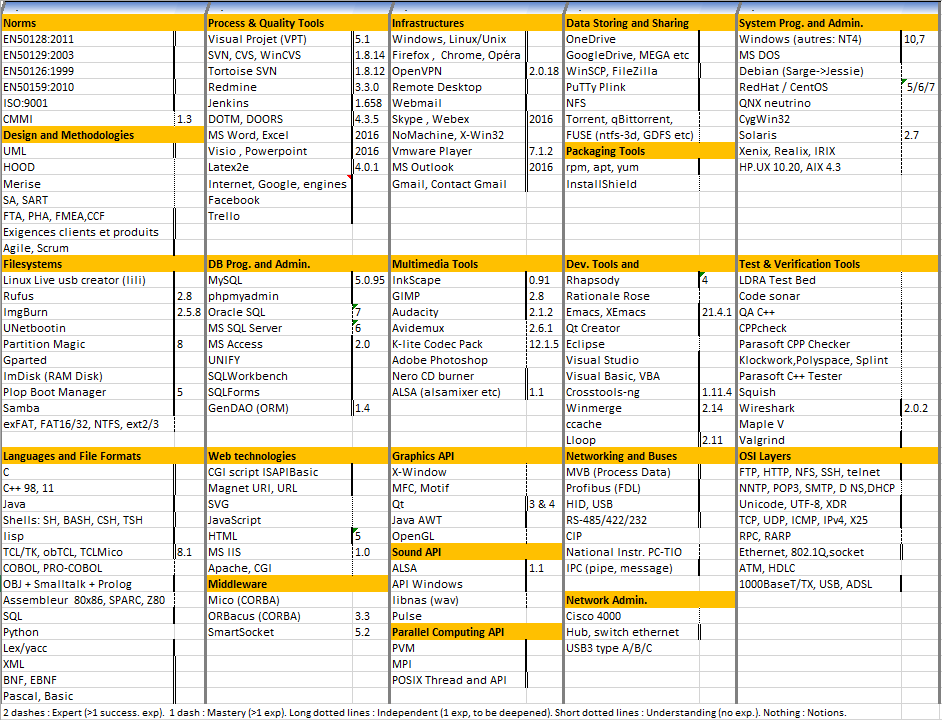
Other used tools and technologies

Overview of other used tools and technologies.